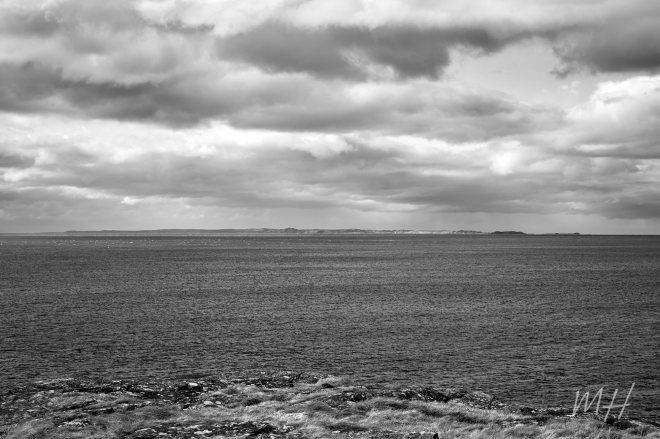
I stand on the western edge of mainland Britain, from where, staring out to sea, I see an island tempting me further west; a stepping stone to the outer limits of UK lands, a response to a call that resonates deep inside of me.
The westerly point of Ardnamurchan is a geologist’s delight. Marking the edge of a body of molten rock (or ‘magma’), that pushed its way into the surrounding rocks millions of years ago, the magmatic rocks that form the end of the Ardnamurchan peninsula are a response to forces which were tearing open the land at the time and beginning to form the North Atlantic Ocean. Having cooled and solidified, these hard, dense rocks now stand proud from the surrounding terrain and provide a wonderful vantage point and contrast from which to gaze upon the island landscape that feels so close, you feel you can nearly touch it.
At around 58 million years old, these rocks form some of the most classic geology of its type and are the subject of many international studies. Just south of due west lies the island of Coll, a 2700-2900 million year old vestige of ancient rocks around 3000 million years old, otherwise isolated to the NW Highlands and the southeastern tip of Skye.
3000 million, or 3 billion, years old! These are some of the oldest rocks in the world and yet, are little more than 20km from some of the youngest rocks in the UK. It can be difficult to comprehend these vast tracts of time so let’s try to put these timeframes into a more human context.
The rocks of Coll (and Tiree) were formed at around 2700-2900 million years (Ma), with associated rocks on the NW coast of Scotland dating to 3100 million years. Volcanic activity in Ardnamurchan ended around 58 million years ago. If we consider the age of the rocks of Ardnamurchan to be equivalent to a one-year-old child, Coll and its equivalents would be around 52 years old (and the Earth would be 79!). Compared to Ardnamurchan, a 52-year-old person stood looking at these rocks is the equivalent of 28 seconds old. Imagine then, Coll as the grandparent, holding their newly born grandchild (us) whilst their older sibling (Ardnamurchan), still a baby themselves, looks on. To further convey the enormity of time between grandparent and child, consider that the last two thousand years (ka) would be a newborn only 18 minutes old, modern humans (Homo sapiens, 300ka) would be a little under 2 days old with our early ancestors (Homo erectus, 2Ma) less than 13 days old. That’s still a long way to go before you reach the ripe old age of the one-year-old child that is Ardnamurchan, let alone the 52-year-old grandparent that is Coll!
Thinking about this in terms of distance, if the age of that human looking out at Coll is considered to equate to 1 metre, a quick sprint (38m) would take me back 2000 years; the origin of modern humans would be only 6km away and their early ancestors only 40km away. I would need to get to Barcelona to see the extinction of the dinosaurs (66Ma), the origins of complex multicellular life (600Ma) would be found at Hawaii but to reach the age of Coll you would have to travel 1.5 times around the Earth!
Whichever way you look at it, the enormity of time is a sobering concept and yet a heartening one. The planet will be here long after we have met our demise and has endured many more severe events through massive volcanic eruptions and meteorite impacts. However, it is also wondrous to think of what those ancient rocks have seen, how deeply they have been buried through all those many processes, and how they came to be so closely positioned, adjacent to the relative yearling that we stand on today and within reach of our newborn fingertips. Those are stories for another time.
 Creative Expression Imagery